Collaborationism
The Tattooist of AuschwitzCollaborationism, the act of cooperating with an occupying or oppressive power, forms the moral core of The Tattooist of Auschwitz. The novel does not treat it as a simple betrayal but as a harrowing ethical dilemma forced upon prisoners who had to navigate survival within the Nazi camp system. For Lale Sokolov, the central figure, collaborationism is not an abstract political category but a lived, daily reality that shapes his identity, his relationships, and his post-war conscience. The narrative repeatedly returns to this theme, weighing the necessity of cooperation against the stigma of complicity, and ultimately reframes the very act of survival as a defiant, heroic choice rather than a shameful compromise.
The Privileged Role and Its Moral Cost
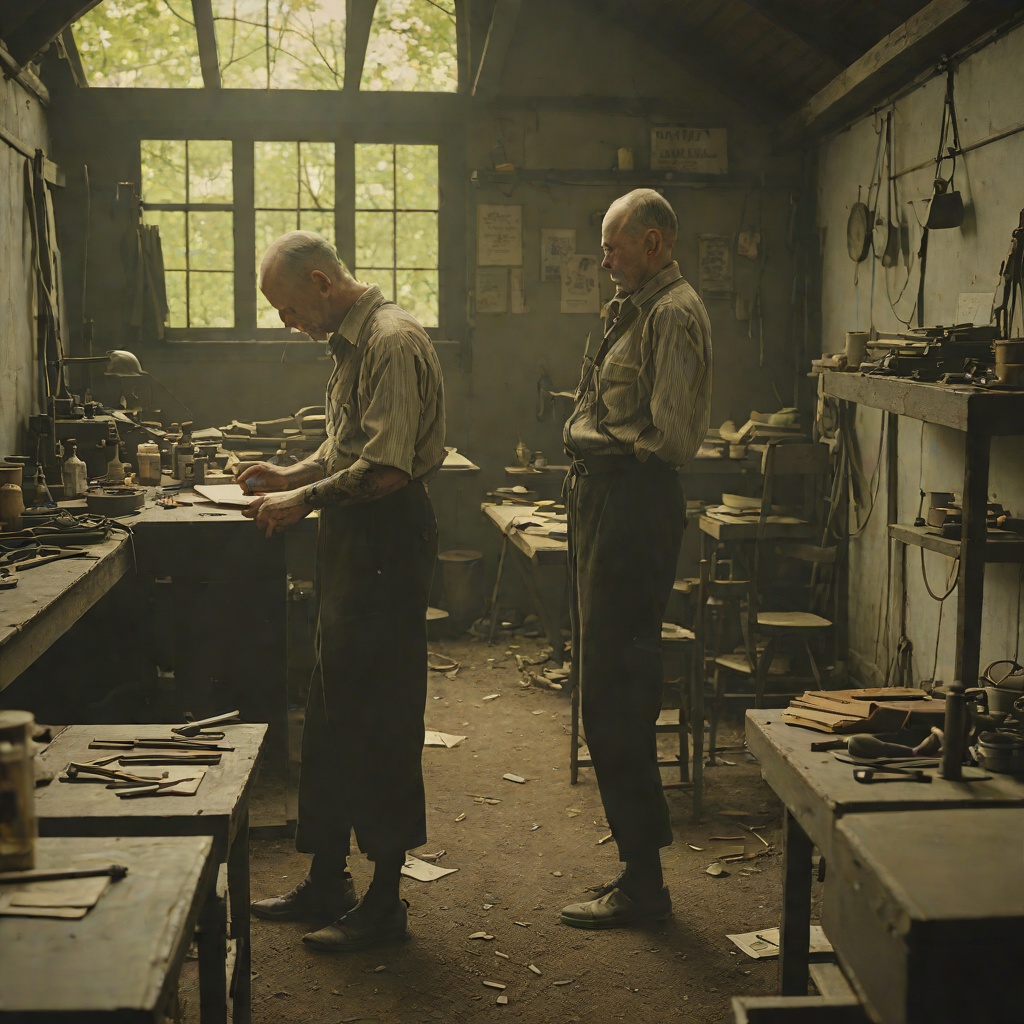
Lale's entanglement with collaborationism begins when he is appointed the Tätowierer, the camp tattooist, a position that grants him significant privileges. He is given a single room immediately inside the door of a new block, a luxury that allows him to sleep stretched out for the first time in months, feeling like a king. This privileged status, however, comes with a heavy psychological price. He becomes acutely aware that others may be jealous of his position or seek to befriend him for their own gain, and he worries about being wrongly accused of something. The narrative notes that as he left his old block, he heard someone mutter the word "collaborator," a label that haunts him. His new role adds to the complexity of surviving, forcing him to navigate a social landscape where food is currency and trust is a dangerous commodity.
The Internal Conflict of Survival
Lale's internal struggle with collaborationism is most explicitly articulated in a conversation with Gita Furman, the woman he loves. When she calls him a hero for choosing to survive, he responds with a confession that reveals the depth of his moral anguish. He states that he has been given the choice of participating in the destruction of his people and has chosen to do so in order to survive, hoping he will not one day be judged a perpetrator or a collaborator. This admission is a pivotal moment, laying bare the ethical tightrope he walks. Gita's response, kissing him and declaring him a hero to her, offers a counter-narrative that reframes his actions. The novel uses this exchange to argue that choosing to live is itself an act of defiance, a form of resistance against the Nazi project of annihilation.
Torture and the Brutal Enforcement of Complicity
The theme of collaborationism is violently dramatized when Lale is imprisoned in the Strafkompanie, the penal unit, from June 16 to July 10, 1944. There, he is tortured by Jakub, a fellow prisoner who drags him to a small, windowless room. Jakub punches Lale in the face, kicks him in the ribs, and handcuffs him to a chain on the back wall. He then tears the shirt from Lale's back and lashes him five times with a birch rod, before pulling down his trousers and whipping him across the buttocks five more times. Lale's yelps are not feigned. This brutal scene underscores the violent consequences of the camp's power structures, where even a privileged prisoner like the Tätowierer is subject to horrific punishment. It also illustrates how the SS used prisoners against each other, blurring the lines between victim and perpetrator and forcing individuals into acts of violence that further complicate any simple moral judgment.
The Post-War Burden of Guilt
Lale's fear of being seen as a collaborator did not end with the war; it became a burden he carried for more than fifty years. The narrative reveals that he and Gita lived with the fear that they might be seen as Nazi collaborators, a guilt that weighed heavily on him. It was only when he began to tell his story to Heather Morris, the author, that he shed this burden. Morris describes how their lives became entwined as he unburdened himself of this guilt, sitting at his kitchen table with trembling hands and a quivering voice. The telling of his story became an act of healing, allowing him to confront and release the shame that had haunted him for decades. This post-war dimension shows that collaborationism was not just a wartime survival strategy but a lasting psychological wound that shaped his entire life.
The Narrative's Reckoning with History
Collaborationism is also a lens through which the novel examines the relationship between memory and history. Morris, as the teller of Lale's story, had to identify how memory and history sometimes waltz in step and sometimes strain to part. She notes that Lale's memories were remarkably clear and precise, matching her research into people, dates, and places, and that there was no parting of memory and history for him. This meticulous grounding in fact serves to legitimize Lale's account, including his morally complex choices. The novel's treatment of collaborationism is thus not a simple condemnation but a nuanced exploration of what it meant to survive in an extraordinary time, deprived of freedom, dignity, names, and identities. By presenting Lale's story as a unique lesson in humanity, the narrative insists that the choices made under unimaginable duress cannot be judged by the standards of ordinary life.